Philadelphia has always had a special relationship with paper. Back in 1690, William Rittenhouse built the first paper mill in North America.
That single mill supplied the colonies with writing paper, helped printers like Benjamin Franklin keep the presses running. They laid the foundation for what would become one of the country’s earliest industrial strengths.
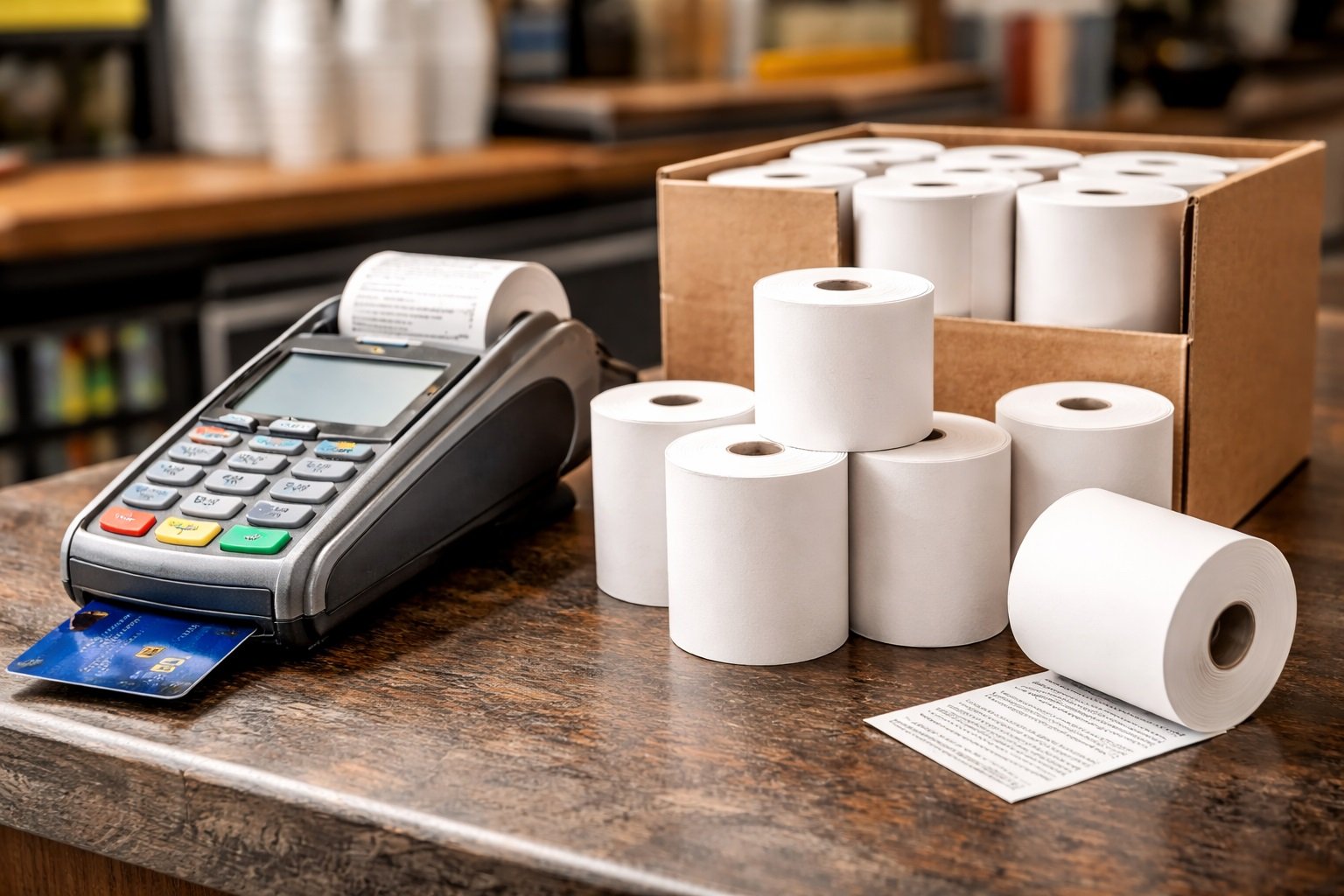
Fast-forward three centuries, and the greater Philadelphia region continues to play a key role in producing high-quality paper. The line of production includes the specialized rolls that power today’s point-of-sale (POS) systems and credit card machines.
While many of the historic mills evolved or closed, Pennsylvania’s paper industry remains robust. Modern facilities convert massive jumbo rolls into the precise sizes needed for everything from restaurant receipts to pharmacy labels.
How Pennsylvania Paper Mills Keep Philadelphia Businesses Running Smoothly
Today’s paper supply chain starts at mills across the state, many within a few hours’ drive of Philadelphia that produce premium base stock.
These mills send jumbo rolls to specialized converting operations in the region, where they’re slit, rewound, and packaged into the familiar 3 1/8″ x 230′ or 2 1/4″ x 50′ rolls you load into your terminal.
This proximity matters. When a weekend rush at a South Philly shop burns through cases faster than expected, local distributors can often deliver the same day or next morning.
National online suppliers might take days longer and charge more for shipping. Choosing regional sources for POS paper and paper for credit card machines also means fewer supply-chain headaches, something every Philadelphia owner appreciates when the registers won’t stop ringing.
Thermal Paper vs. Bond Paper: Understanding the Two Main Options
Not all receipt paper is created equal. The two dominant types—thermal and bond—serve different equipment and priorities.
Thermal paper is coated with a heat-sensitive chemical layer. When the print head in a thermal printer applies precise heat, the coating turns black to form text and images. No ink or ribbon required.
That’s why thermal rolls dominate modern POS systems: they print faster, quieter, and with virtually no maintenance.
Bond paper (sometimes called “impact” or “single-ply” paper) is traditional wood-free stock that requires an ink ribbon and a dot-matrix style printer to strike the page.
You still see bond rolls in some kitchens (where oil and heat would ruin thermal receipts) or older systems that need carbon copies. Bond is tougher against grease and moisture, but prints slower and louder, and you have to change ribbons regularly.
For most Philadelphia retailers and restaurants upgrading equipment in the last decade, thermal has become the default. It’s cleaner, faster, and far more cost-effective over time.
Push for Higher Standards and Sustainable Materials
One Pennsylvania mill leading the charge in quality and sustainability is American Eagle Paper Mills in Tyrone. Former employees and local investors after the original facility closed, American Eagle made a bold decision: become the nation’s largest producer of 100% recycled premium printing and converting papers.
They invested heavily, in deinking technology, a natural-gas power plant that slashed greenhouse gases by nearly 70%, and water-recycling systems that cut usage by over 80%.
Today the mill turns post-consumer waste into bright, smooth base stock that converters use for everything from office paper to the jumbo rolls that eventually become POS paper.
All thermal POS paper comes directly from American Eagle. Their rigorous manufacturing standards—tight brightness controls, precise caliper uniformity, and dust-free production, influence the entire supply chain.
Looking Ahead for Philadelphia’s Merchants
Philadelphia’s paper story runs deep. The Rittenhouse mill once supplied the Continental Congress. Today, recycled jumbo rolls from modern mills support converters across the region.
Philadelphia’s paper story runs deep. The Rittenhouse mill supplied the Continental Congress. Today, modern mills produce recycled jumbo rolls that support converters across the region.
Next time you tear off a receipt for a customer, take a second to appreciate the journey that roll took: from recycled fiber in a Pennsylvania mill, through precise converting, all the way to your terminal.
In Philadelphia, quality paper isn’t just a supply, it’s tradition.